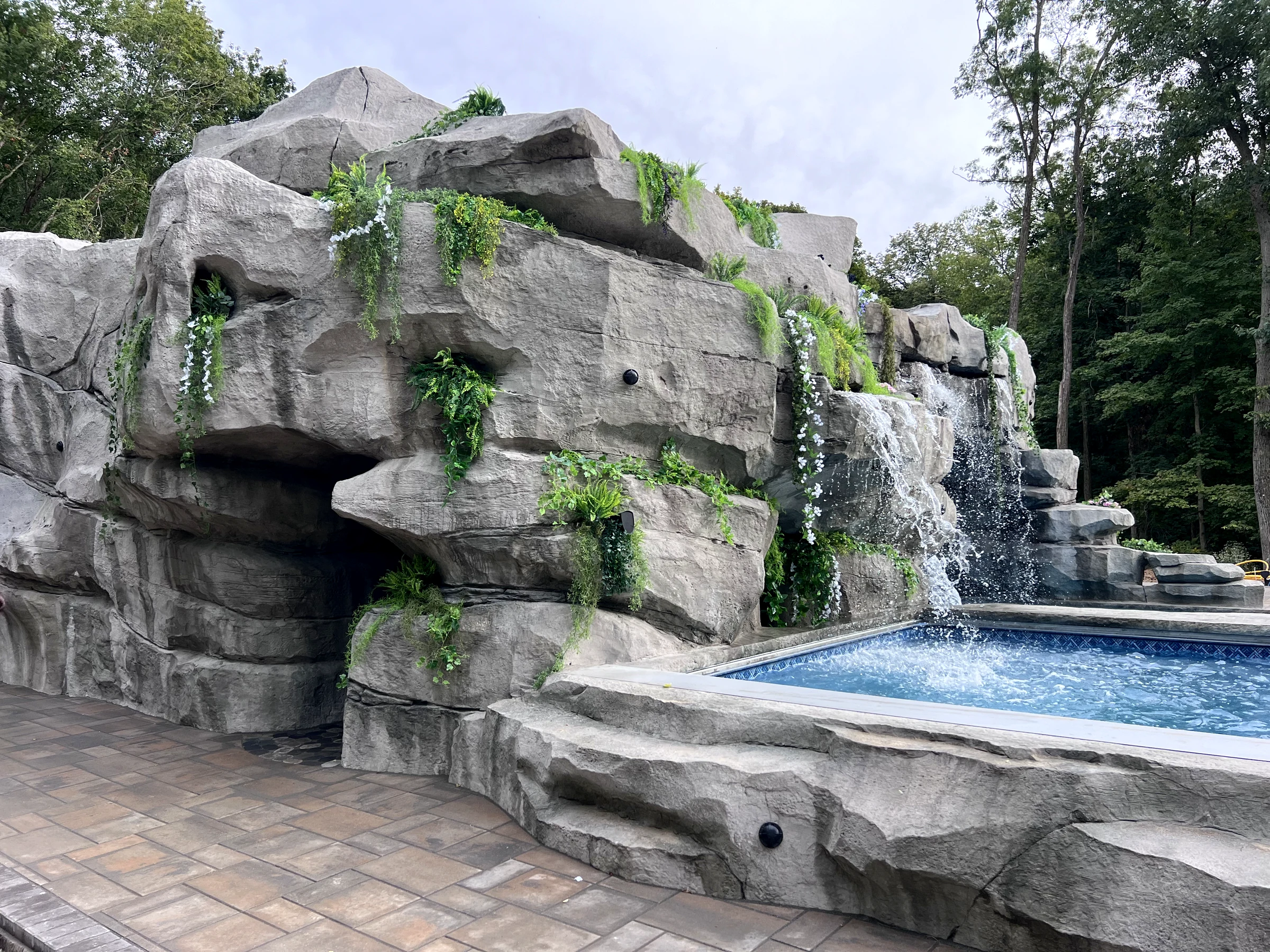
Artificial rock is the signature of a Cole Schwigen Pools project, and it is also the part of our work that gets misunderstood most often. The word artificial makes people picture something hollow and obviously fake. What we build is closer to the opposite: a permanent, structurally reinforced form that is shaped and colored to read as native stone, engineered specifically for the pool it surrounds.
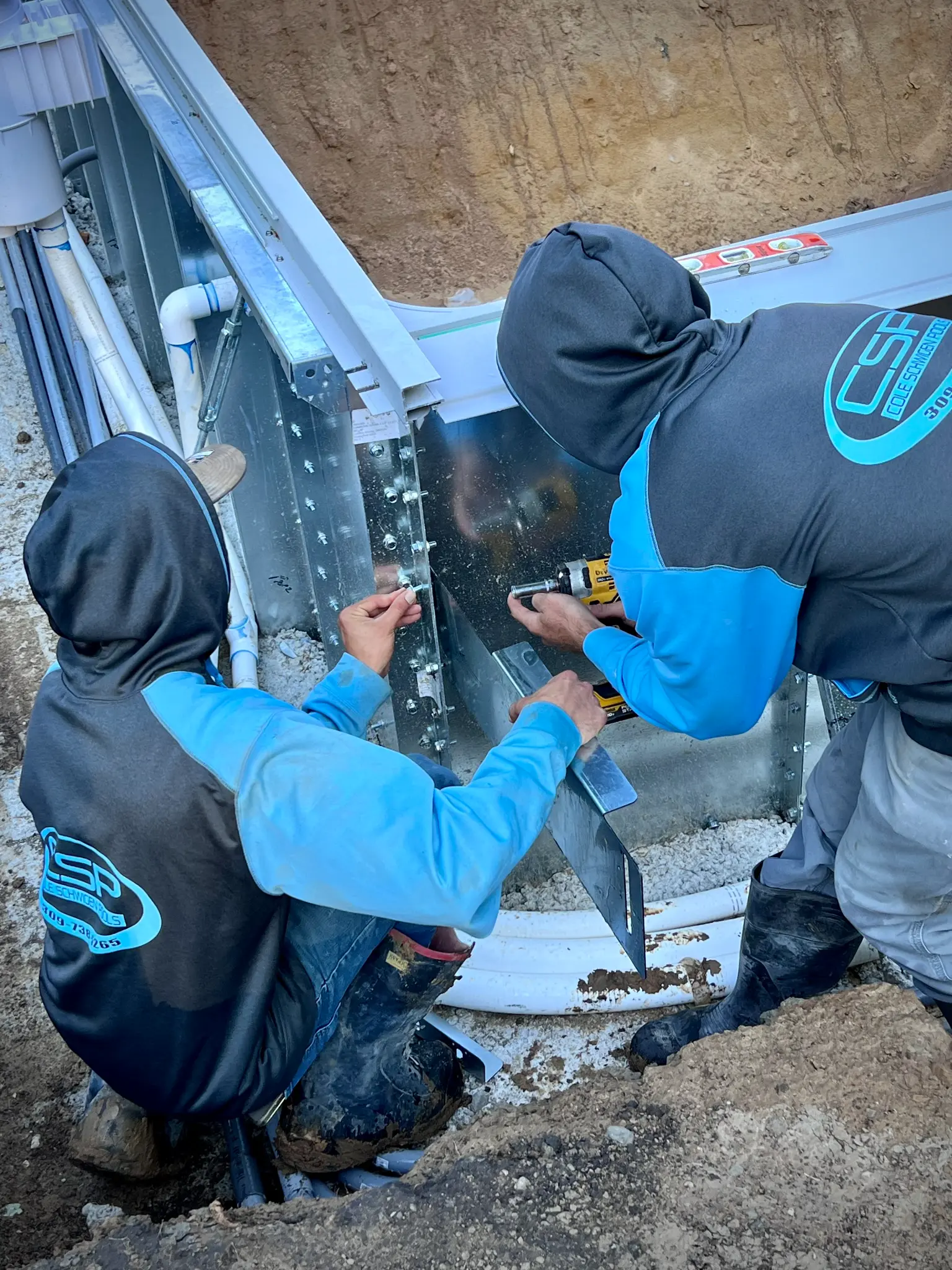
The process starts with structure, not appearance. A steel framework defines the mass and geometry of the feature and is anchored so it will not move with time, water pressure, or freeze and thaw cycles. That framework is covered and then finished with a specialized concrete application that is sculpted by hand while it is still workable. Texture, fracture lines, how an edge breaks, and where a shadow falls are all decisions made in that window. Color is applied in layers so the surface reads with depth rather than as a single flat tone.
That sculpting window is the part that cannot be rushed, and it explains why this work is priced as craft rather than as material. Once the concrete is applied, there is a limited period during which it can be shaped. Every fracture line, every recessed shadow, every broken edge has to be carved in that window by someone who understands what real stone does. Wait too long and the surface is set. Move too fast and the detail is shallow. There is no going back and adding character later, which is why the person holding the tool matters more than the specification sheet.
Color is its own discipline and it is where most of the realism lives. Natural stone is never one color. It carries a base tone, mineral variation, darker recesses where water and time have collected, and lighter high points where weather has worn it. Achieving that requires multiple applications at different dilutions, working into the texture rather than over it, so the deep areas read darker and the raised areas catch light the way real rock does. A single sprayed tone over good sculpting still looks artificial, because the eye reads color depth before it reads shape.
This matters in the Quad Cities specifically because of our winters. Placed boulders and stacked stone rely on gravity and mortar joints. Water finds those joints, freezes, expands, and works them apart over the years. Anyone who has watched a stacked feature slowly shift, gap, and stain knows the pattern. A monolithic sculpted structure has far fewer places for water to get inside and lever things apart, which is a meaningful durability advantage in a climate that crosses the freezing line repeatedly every winter.
It is worth being precise about why freeze and thaw is so destructive here rather than simply citing cold. Water expands as it freezes. When it has worked into a joint, a seam, or a void, that expansion acts as a wedge. One cycle does little. Our winters deliver that cycle many times, sometimes within a single week during a variable stretch. Each cycle widens the opening slightly, which admits more water, which freezes again. That is the mechanism behind gapped joints, displaced stone, and the cracked mortar that shows up a few winters into a stacked feature.
There is also a design argument that has nothing to do with durability. Natural boulders come in whatever shapes the quarry produced. You place them, you work around them, and you accept their limits. Sculpted rock is built to the design instead, which means a waterfall can land exactly where you want it, a grotto can be sized for actual people to sit inside comfortably, steps can be integrated where they make sense, and the feature can transition into the pool structure as one continuous element rather than a collection of pieces set nearby.
Water behavior is the underrated benefit of designing the form rather than accepting it. How a waterfall sounds and looks depends on the exact geometry of the lip it leaves and the surface it lands on. A thin sheet reads differently than a broken cascade, and a fall into open water sounds different than one landing on a shelf. When the rock is sculpted, that lip can be shaped and adjusted deliberately to produce the effect the owner actually wants. With placed boulders, water goes wherever the gaps between stones allow, and the sound is whatever the arrangement happens to produce.
Weight and logistics are the practical bonus. Moving genuinely large boulders into a finished backyard is difficult, sometimes impossible, and frequently destructive to everything they have to cross. Sculpted rock is built in place. That opens up scale and placement options on properties where hauling stone is not realistic, and it means less collateral damage to the yard you are trying to improve.
Maintenance is straightforward, which surprises people who expect something engineered to be fragile. The surface is a hard cementitious shell, so it is cleaned much like any other pool hardscape. It does not require sealing on a rigid schedule, it does not shed loose pieces, and it does not develop the shifting joints that make stacked features look neglected. Like any exterior surface it will collect what the season deposits on it, and like any pool surround it benefits from reasonable water chemistry, but there is no specialized upkeep regimen attached to owning it.
The honest caveat is that this work depends entirely on the skill of the person doing it. Bad artificial rock is unmistakable. It looks smooth where it should be broken, repeats the same texture, and wears a flat monochrome color that no real stone ever had. Convincing rock work comes from understanding how stone actually fractures and weathers, from varying texture at different scales, and from patient color layering. It is craft work, and it takes years to get right.
If you want a short checklist for evaluating rock work in person, look at three things. Look at the edges, because rushed work rounds them where real stone would break sharply. Look at whether the texture repeats, since a mold-like rhythm gives away hurried application. Look into the recesses to see whether the color deepens where water and shadow would naturally collect. Good work passes all three from arm's length, which is exactly where visitors to your backyard will be standing.
If you have seen artificial rock you did not like, there is a reasonable chance you were looking at rushed execution rather than a limitation of the method. Look at completed work in person when you can, and pay attention to the edges and the color depth. That is where the difference shows.
Want project guidance that takes the full ownership experience into account?
Start a conversation